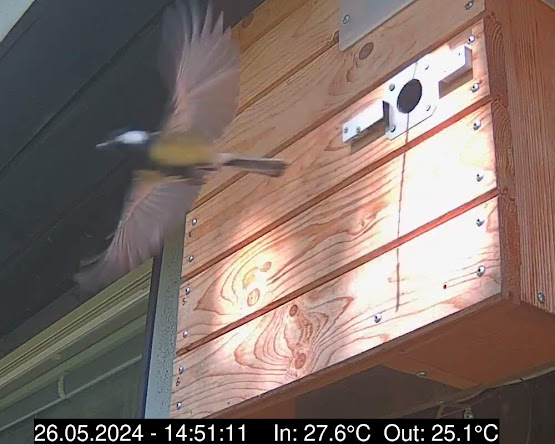
Nyt kun tiaiset ovat lähteneet, kirjosieppo saa mieluusti käydä ja vaikka jäädäkin. Ei ole harvinaista, että kirjosieppo aloitta pesinnän vielä kesäkuun alussa.
Now that the tits have left, the pied flycatcher is more than welcome to visit — or even stay. It’s not uncommon for a pied flycatcher to start nesting even in early June.
Pelkkä koiras ei sitä kuitenkaan tee, eikä naarasta ole näkynyt.
But the male won’t do it alone, and there’s been no sign of a female.
Poikaset ovat lähteneet pesästä. The fledglings have left the nest.
Poikaset lähtivät pesästä kahtena peräkkäisenä päivänä, 30. ja 31.5.2025. Lähtöajat olivat:
30.5.2025 klo 13:02:00
30.5.2025 klo 13:04:20
31.5.2025 klo 12:19:26
31.5.2025 klo 12:22:31
31.5.2025 klo 12:25:42
Emot kävivät vielä viimeisen lähdön jälkeen monta kertaa tuomassa ruokaa ja toteamassa pöntön tyhjäksi.
The fledglings left the nest on two consecutive days, May 30 and 31, 2025. The departure times were:
May 30, 2025 at 13:02:00
May 30, 2025 at 13:04:20
May 31, 2025 at 12:19:26
May 31, 2025 at 12:22:31
May 31, 2025 at 12:25:42
After the last fledgling had left, the parent birds returned several times with food, only to find the nest box empty.
Porttilaskurin päivättäiset ja pesinnän eri vaihdeiden lukemat näkyvät kaaviossa.
The gate counter’s daily readings and the values for different stages of the nesting period are shown in the chart.
Koko pesinnän aikana laskuri kirjasi 24979 kulkua, joista pesäpoikasvaiheen aikana 22180. Kun jokainen pöntössä käynti kasvattaa laskurin lukemaa kahdella, saadaa käyntien määrät jakamalla luvut kahdella. Poikasten ruokintaan tarvittiin noin kymmenen tuhatta pöntössä käyntiä.
During the entire nesting period, the counter recorded 24,979 passages, of which 22,180 occurred during the nestling stage. Since each visit to the nest box increases the counter by two, the number of visits can be calculated by dividing these figures by two. Approximately 10,000 visits were made to feed the chicks.
Pestintä onnistui kaiken kaikkiaan hyvin. Munia oli seitsemän, joista kuusi kuoriutui ja niistä viisi selvisi lentokykyisiksi. Kesä on vasta alussa ja talitiainen ehtisi hyvin pesimään toisenkin kerran. Tässä pöntössä ei ole koskaan ollut kahta pesintää kesässä, mutta on se silti mahdollista. Jäämme odottamaan tulevaa.
Overall, the nesting was successful. There were seven eggs, six of which hatched, and five of those chicks made it to the fledging stage. Summer is only just beginning, so the great tit would still have time for a second brood. Although this particular nest box has never hosted two broods in one summer, it’s still possible. We’ll be watching to see what happens next.
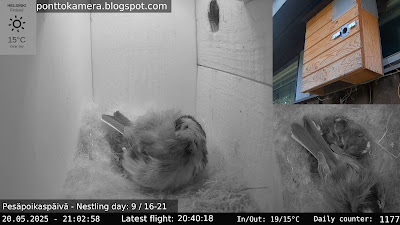
Yksi poikasista lähti pienelle kävelylle pesän reunalle. Ulkoa kuuluva kattomaalarin maaliruiskun ääni ei tuntunut pesuetta häiritsevät, sen sijaan kolinat saivat emon vähän varuilleen.
One of the chicks went for a little walk to the edge of the nest. The sound of the roof painter’s spray gun coming from outside didn’t seem to bother the brood, but the clattering noises made the mother a bit cautious.
Poikasia ei ole toissapäivän jälkeen näkynyt kuin viisi. Pesän pohjalla näkyy kuoriutumaton muna, mutta kuudennen poikasen kohtalosta ei ole havaintoa.
Laskuri päätyi taas uuteen ennätykseen. Se näytti päivän päätteeksi suurinta lukemaa tähän asti.
Only five chicks have been seen since the day before yesterday. An unhatched egg is visible at the bottom of the nest, but there’s no sign of what happened to the sixth chick.
The counter hit a new record again. By the end of the day, it showed the highest number so far.
Vieläkö saamme suurempia lukemia pesinnän loppuvaiheen aikana?
Will we see even higher numbers during the final stages of the nesting period?
Kasvavat poikaset vaativat joka päivä enemmän ruokaa. Sitä myös tulee, käyntien määrästä päätelleen. Laskuri ylitti tänään ensimmäistä kertaa tuhannen rajan. Lopullinen lukema päivän päätteeksi oli 1070. Ruokinta oli tasaista pitkin päivää.
The growing chicks require more food each day. And food is indeed coming in, judging by the number of visits. Today, the counter exceeded the thousand mark for the first time. The final count at the end of the day was 1,070. Feeding was steady throughout the day.
Seitsemästä munasta kuoriutui kuusi poikasta, jotka ovat kaikki elossa. Ruokinta työllistää vanhempia joka päivä enemmän, mikä näkyy selvästi laskurin luvuissa. Alla kuva laskurin päiväkohtaisista tuloksista.
Six out of seven eggs hatched, and all six chicks are alive. Feeding them keeps the parents increasingly busy each day, which is clearly reflected in the counter's numbers. Below is an image showing the counter’s daily results.
Tuntikohtaiset lukemat osoittavat ruokintakäynti painottuvat jonkin verran enemmän alku- kuin loppupäivään. Öisin ei ole liikennettä lainkaan.
The hourly readings show that feeding visits are somewhat more frequent in the early part of the day than later. There is no activity at all during the night.
Laskuri perustuu lentoaukon suulla olevaan ilmaisimeen, joka havahtuu, kun lintu katkaisee valonsäteen. Laskuri ei tunnista sitä, meneekö lintu aukosta sisään vai ulos, joten se voi laskea käynniksi myös sen, jos lintu käy aukolla ja kääntyy takaisin. Se voi laskea väärin myös, jos lintu jää pidemmäksi aikaa aukolle ja katkaisee valonsäteen moneen kertaan. Laskuri on tällä hetkellä säädettyn niin, että se tulkitsee liikesarjan yhdeksi liikkeeksi ja liikesarjan päättyneeksi, kun edellisestä liikkeestä on kulunut kaksi sekuntia.
The counter is based on a sensor located at the nest hole, which is triggered when a bird breaks the light beam. The counter does not distinguish whether the bird is entering or exiting, so it may register a visit even if the bird only approaches the hole and then turns back. It can also miscount if a bird lingers at the entrance and breaks the beam multiple times. Currently, the counter is configured to interpret a sequence of movements as a single visit and to consider the sequence ended if no movement is detected for two seconds.
Mielenkiinnon vuoksi, validoidaan laskuri, katsotaan, kuinka oikein se laskee. Otetaan tätä varten video yhden tunnin ajalta. Valitaan tunti väliltä 9:00 - 10:00. Lasketaan siitä käsin, kuinka monta kertaa lintu on mennyt aukon läpi ja verrataan sitä laskurin lukemaan. Tarkastuslaskennan lukemat näkyvät videolla kuvan alalaidassa keskellä.
Out of curiosity, let's validate the counter to see how accurately it counts. For this purpose, we’ll use one hour of video footage. We'll select the hour between 9:00 and 10:00. We'll manually count how many times a bird passes through the nest hole and compare it to the counter’s reading. The results of the manual count are displayed on the video at the bottom center of the image.
(Videolla kuuluu taustalla korppien raakuntaan. Korpit ovat saapuneet pysyvästi Helsinkiin! In the video, you can hear ravens croaking in the background. Ravens have permanently arrived in Helsinki!)
Laskuri näytti tunnin alussa lukemaa 250 ja tunnin lopussa 305. Laskurin mukaan käyntejä 55 kpl, tarkistuslaskennan mukaan 51 kpl. Laskuri laski neljä käyntiä liikaa. Lukemista voinee vähentää 10 % niin päästään lähemmäs totuutta.
At the beginning of the hour, the counter showed a reading of 250, and by the end, it had reached 305. According to the counter, there were 55 visits, while the manual verification counted 51. The counter overcounted by four visits. Reducing the readings by about 10% should bring the results closer to the actual number.
Joka tapauksessa, laskuri osoittaa hienosti, miten paljon työtä tämän keskimääräistä pienemmän poikueen ruokkiminen vaatii. Ilmeksesti ravintoa on tänä keväänä hyvin saatavissa, koska kaikki kuoriutuneet poikaset ovat elossa ja näyttävät kasvaneen jokseenkin yhtä paljon kaikki.
In any case, the counter clearly demonstrates how much effort is required to feed this smaller-than-average brood. Apparently, food is plentiful this spring, as all the hatched chicks are alive and appear to have grown at roughly the same rate.
Kameran iso kuva on nyt vaihdetty näyttämään sivukuvaa. Se on mielekniintoinen pesinnän tässä vaiheessa kuin kattokameran kuva.
The main camera view has now been changed to show the side view. At this stage of the nesting, it’s more interesting than the overhead camera image.
Haudontapäivä 12 ja ainakin neljä poikasta kuoriutui. Päivän videolla nähdään niistä kolme, joskin kaikki kuoriutuivat emon alla, niin kovin paljoa siitä ei nähdä.
Incubation day 12, and at least four chicks have hatched. In today’s video, three of them can be seen, although they all hatched underneath the mom, so there isn’t much visible.
Videon koostamisen jälkeen kuoruitui vielä yksi. Emo ei syö kuoria yöllä, koska se ei näe niitä. Pönttö on valaistu inftapunavalolla, jonka kamera näkee, mutta lintu, ja ihminen, ei näe.
One more hatched after the video was compiled. The parent bird doesn’t eat the eggshells at night because it can’t see them. The nest box is illuminated with infrared light, which the camera can see, but the bird—and humans—cannot.
Viimeiset kolme kuoriutuvat luultavasti yöllä tai huomenna päivällä.
The last three will likely hatch during the night or sometime tomorrow.
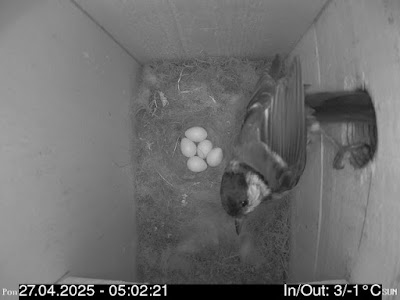
Pesässä on seitsemän munaa ja emo näyttää aloittelevan hautomista. Huomennaa saattaa tulla kahdeksas muna, koska yleensä haudonnan alkuvaiheessa munitaan vielä yksi.
There are seven eggs in the nest, and the female seems to be starting incubation. An eighth egg might appear tomorrow, as it's common for one more to be laid at the beginning of the incubation phase.
Kirjosieppo on ollut yllättävän vähän häiriöksi tänä vuonna. Tänää se kuitenkin kävi kurkkimassa tintin pesään, mutta tuli määrätietoisesti häädetyksi. Päivän videolla nähdään tilanne.
The pied flycatcher has been surprisingly little of a nuisance this year. However, today it did peek into the tit's nest but was promptly and decisively chased away. The day's video shows the encounter.
Pesässä nähtiin tänään ensimmäinen muna. Niitä voi olla useampiakin, koska talitiainen peittää ne pois lähtiessään niin hyvin, että niitä ei näy. Tämä yksi kuitenkin näkyi heti aamulla.
The first egg was seen in the nest today. There might be more, as the great tit covers them so well when leaving that they aren't visible. However, this one was clearly visible in the morning.
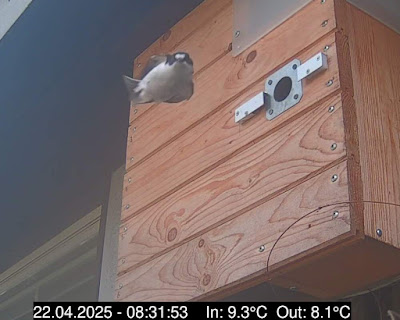
Kirjosieppokin on saapunut jo. Se kävi aukolla kurkkaamassa, ei mennyt pönttöön sisälle. Toivottavasti pysyykin ulkona. Sille on pihassa muita, tyhjiä pönttöjä.
The pied flycatcher has arrived as well. It peeked in through the entrance but didn't go inside the box. Hopefully it stays out. There are other empty nest boxes in the yard for it
Pesänrakennus on vauhdilla lähtenyt liikkeelle sään nopeasti lämmetessä. Päivän video on kooste liiketunnistuksen tallentamista still-kuvista. Lintu käy pöntössä liki sata kertaa päivän aikana ja tulostakin syntyi.
Live-striimi on päällä ja nyt ensimmäistä kertaa valokuituyhteyden päässä. Se on parempi ja pitäisi olla vakaampi kuin aiemmin.
Nest building has quickly gotten underway as the weather has warmed up rapidly. Today's video is a compilation of still images captured by motion detection. The bird visits the nest box nearly a hundred times throughout the day — and the results are starting to show.
The live stream is on, and for the first time, it's connected via a fiber optic connection. It's better and should be more stable than before.
Tänään oli kevään lämpimin päivä. Lämpötila oli enimillään lähimmällä Ilmatieteenlaitoksen mittausasemalla 14,6 ºC pöntön luona talon ulkoseinällä liki 20 ºC. Talitintti huomasi tämän myös ja toi aamupäivällä ensimmäiset pesämateriaalit pönttöön. Sää kylmenee lähipäivinä, joten pesänrakennukseen voi olettaa tulevan taukoa joksikin aikaa.
Kyseessä on selvästi pariskunta, koska aukolla on toinen lintu kurkkimassa sisään ja se on myös talitiainen, kuten ulkokameran kuva samalta ajan hetkeltä paljastaa.
Videostriimi on päällä ja löytyy tämän sivun ylälaidasta, tai tästä linkistä. Nettiyhteys toimii nyt ensimmäistä kertaa valokuidulla, joten striimin toiminee luotettavammin kuin aiemmin ja sen bittivirtaa on myös voitu kasvattaa kuvanlaadun parantamiseksi.
Kevät tekee tuloaan. Viime aikoina pöntössä on usein käynyt lintuja, sekä tali- että sinitiaisia. Kuvat nähtäsivvä arkistossa.
Sunnuntaina, 9.3.2025 klo 17:43 saapui talitiainen ja jäi yöksi. Saa nähdä, joko tämä aloittelee pesän rakentamista. Maa on joka tapauksessa jo täysin lumeton ja sula, joten materiaaliakin lienee tarjolla.
Koko poikue on menehtynyt. Eilen illalla kaksi poikasta vielä liikkui, tänään ei enää yksikään.
Tämä on Pönttökameran 24. vuosi, eikä koskaan aiemmin ole sattunut mitään vastaavaa. On enemmän sääntö kuin poikkeus, että osa poikasista kuolee. Joskus on yhdeksän munan poikueesta päässyt lentokykyisiksi vain kaksi tai kolme, mutta koko poikue on kuollut vain kerran aiemmin ja se johtui siitä, että emo katosi heti kuoriutumisen jälkeen. Silloin poikaset kuolivat nälkään.
Harvemmin on myöskään kuollut useita poikasia saman päivän aikana.
En keksi muuta syytä kuin joku tauti tai myrkky. Pesän pehmusteena on todennäköisesti koiran karvaa. Jos koiralla on ollut punkkipanta, tai se on saanut Stronghold tms. lloishäätökäsittelyn, näitä tehoaineita on voinut päätyä karvojen mukana pesään ja ne voivat olla myrkyllisiä poikasille, mutta eivät aikuisille linnuille.
Jostain lähiseudun pihalta on voinut pesämateriaalien mukana tulla torjunta-aineita, hyönteismyrkkyjä tms.
Nämä toki pelkkää arviailua.
Tapaus on sen verran outo, että päätin lähettää koko poikueen Elintarvikevirastoon tukittavaksi. Näitä villieläinnäytteitä ottava mielellään vastaan tutkittavaksi, koska niiden avulla voidaan selvittää luonnon kokonaistilaa ja juuri tämän tyyppiset tapaukset voivat olla hyödyllisiä tutkimuskohteita. Jos ottavat asian tutkittavakseen, lähettävät aikanaan raportin, jossa tutkimustulokset kerrotaan. Jos saan luvan, julkaisen raportin täällä.
The entire brood has perished. Last night, two nestlings were still moving, but today, not a single one is alive.
This is the 24th year of my Nest Box Camera, and nothing like this has ever happened before. It is more the rule than the exception that some of the nestlings die. Sometimes, out of a brood of nine eggs, only two or three reach fledging, but an entire brood has only died once before, and that was because the mother disappeared immediately after hatching. In that case, the nestlings died of starvation.
It is also rare for several nestlings to die on the same day.
I can't think of any other reason than some disease or poison. The nest lining is likely made of dog hair.
If the dog had a tick collar or received Stronghold or a similar parasitic treatment, these active substances might have ended up in the nest with the hair and could be toxic to the nestlings, but not to the adult birds.
Pesticides, insecticides, or similar substances might have come into the nest with the nesting materials from some nearby yard.
Of course, this is all just speculation.
The case is so unusual that I decided to send the entire brood to the Finnish Food Authority for examination. They are happy to accept wildlife samples for study, as these can help determine the overall state of nature, and cases like this can be useful research subjects. If they decide to investigate, they will eventually send a report detailing the research results. If I get permission, I will publish the report here.
Eilen kaikki näytti vielä hyvältä ja normaalilta. Tänään poikasia alkoi menehtyä, illalla varmuudella enää kaksi oli elossa. Mitään näkyvää, selvää syytä ei ole. Niille tuotiin ruokaa, mutta eivät tahtoneet syödä, tai sitten tarjotut toukat olivat liian isoja tms. On iso riski sille, että kaksi elossa ollutta eivät selviä, huominen näyttää.
Yesterday everything still looked good and normal. Today the chicks started to die, and by evening only two were definitely still alive. There is no visible, clear reason. They were given food, but they didn't seem to want to eat, or perhaps the larvae offered were too big or something. There is a high risk that the two remaining ones won't survive; tomorrow will tell.
Kaksi poikasta lisää kuoriutui tänään, yksi muna edelleen jäljellä. Jos se ei huomenna kuoriudu, se tuskin enää ehtii muiden poikasten kasvuvauhtiin mukaan.
Two more chicks hatched today, with one egg still remaining. If it doesn't hatch tomorrow, it likely won't be able to keep up with the growth pace of the other chicks.
Emolinnuilla alkaa olla kiirettä ja lentoliikenne tulee lähipäivinä vain lisääntymään. Porttilaskuri näyttää nyt melko hyvin oikein kasvattamalla laskurin lukemaa jokaisesta tulosta ja poistumisesta yhdellä. Jos lintu jää aukolle koputtelemaan tai muuten vaan katselemaan maisemia, tulee yhdestä tulosta tai lähdöstä edelleen enemmän kuin yksi numero lisää laskuriin. Kovin paljon näitä ei nyt näytä kuitenkaan tapahtuvan, joten voimme luottaa laskurin lukemaan, kun siitä vähennetään n. 5%. Tänään illalla laskuri näytti 431, joten n. 400 kertaa on aukosta kuljettu. Koska yksi käynti lisää laskurin lukemaa kahdella, on ruokintakäyntejä ollut n. 200.
The parent birds are starting to get busy, and air traffic will only increase in the coming days. The gate counter now shows a fairly accurate count, increasing by one for each entry and exit. If a bird stops at the opening to peck or just to enjoy the view, one entry or exit still adds more than one number to the counter. However, this doesn't seem to happen often, so we can trust the counter's reading after subtracting about 5%. This evening, the counter showed 431, so there have been approximately 400 passes through the opening. Since each visit increases the counter by two, there have been around 200 feeding visits.
Neljä poikasta kuoroitui päivän aikana. Ensimmäinen varhain aamuyöllä klo 3:44. Kirjosieppokin kävi monta kertaa häiritsemässä.
Four chicks hatched during the day. The first one early in the morning at 3:44 AM. Even the pied flycatcher came by several times to disturb them.
Päivän toisella videolla nähdään yhden poikasen kuoroituminen. Muut kuoriutuivat emon alla piilossa kameralta, mutta tämä yksi näkyy alusta loppuun.
In the second video of the day, we can see one chick hatching. The others hatched hidden under the mother, out of view of the camera, but this one is visible from start to finish.
Kolme munaa jäi vielä kuoriutumatta. Ne luultavasti kuoriutuvat huomenna.
Three eggs have yet to hatch. They will probably hatch tomorrow.